CMH Grow Light [Beginner Guide] | Best Ceramic Metal Halide Lights for Growers
Green Thumb Gardener occasionally links to products and services offered by vendors to help with your gardening needs. Some are affiliate links — we earn a small commission if items are purchased, at no cost to you. See our affiliate disclosure.
![CMH Grow Light [Beginner Guide] | Best Ceramic Metal Halide Lights for Growers](/wp-content/uploads/2020/02/cmh-grow-lights.jpg)

About the Author: Jeremy Starke
I've been growing vegetables since I was 12 — over 30 years in the dirt. I share what actually works in my own Zone 6b garden, and what I wish someone had told me when I started.
Zone 6b · North Carolina · Gardening since age 12Ceramic Metal Halide Lights or CMH Grow Lights are fitting for most indoor growers, indoor vegetable gardeners, or other plant enthusiasts who have a grow room. We will tackle educating you on how these metal halide grow lights work and which is the best CMH grow lights.
Basic science tells us that plants cannot grow without sunlight. The process, as most refer to it, is photosynthesis.
Best CMH Grow Light
What is the Best CMH Grow Light?
We will show you a quick review of several products of CMH light that are available in the online and offline markets today.
Keep in mind that these products are not listed in any particular order or Bbyprice.
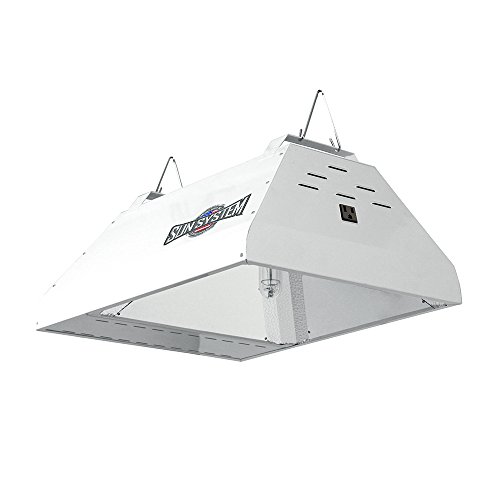
- 98% reflective German aluminum
- Highly efficient agriculturally engineered
- Uniform Lighting
Sun System Grow Light - LEC 315 Light Emitting Metal Halide
The Sun System CMH bulb tops our list because it is the most popular Ceramic Metal Halide available in the market today.
It comes with all of its parts ready for coupling and use.
This cmh product has an all in one reflector with vertically hanging bulbs.
The reflective material used here is German aluminum which has 98% reflection.
The bulb has a coverage area of 4×4. This design ensures uniform lighting for your crops making it the perfect choice for the vegetative and flowering stages of your crops.
What’s more? It comes with a one year’s warranty.
Pros
- Long lifespan of 20,000 hours
- Low heat emission
- German aluminum reflective material for even light distribution
Cons
- More expensive than most other Ceramic Metal Halide bulbs
- Possible overheating of crops at close range

- Professional Results Made Easy
- High-Tech Ballast
- Ultra-High Reflectivity Rating
VIVOSUN 315W Ceramic Metal Halide CMH/CDM Grow Light Kit
This light uses Italian VEGA Aluminium hoods which gives it a 98% reflection rate.
The ballast is built into the reflector and uses Square-Wave technology.
Although VIVOSUN does not rank so high among users, compared to Sun Systems, they are a worthy competitor and have quite a considerable market share.
Pros
- Long lifespan of 24,000 hours on average
- Comes with a 3-year warranty
- Italian VEGA Aluminium hoods provide a more even distribution of light
Cons
- It does not come with a bulb. Users will have to buy theirs instead.
- More expensive than most other bulbs
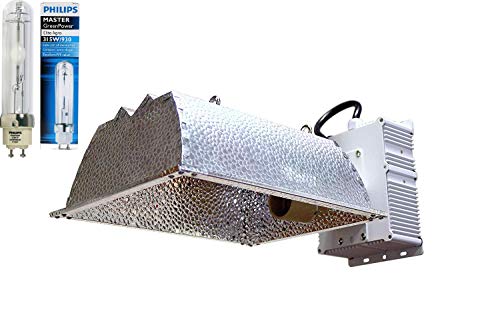
Grow Co. 315W Ceramic Metal Halide CMH System Light Bulb
These products comes from one of the most trusted brands in the grow lights market.
The Grow Co. system grow light is equipped with a 3100K full spectrum Phillips CMH bulb which runs on between 120 to 240 volts.
Its low heat production means that you have less to worry about overheating your crops.
Pros
- Energy efficiency and low heat emission
- It comes with a 240 volts power cord
- Comes with a two-year warranty
Cons
- Danger to eyes and skin due to heavy UV radiation. It requires protective eyeglasses and gloves.
- It has no timer
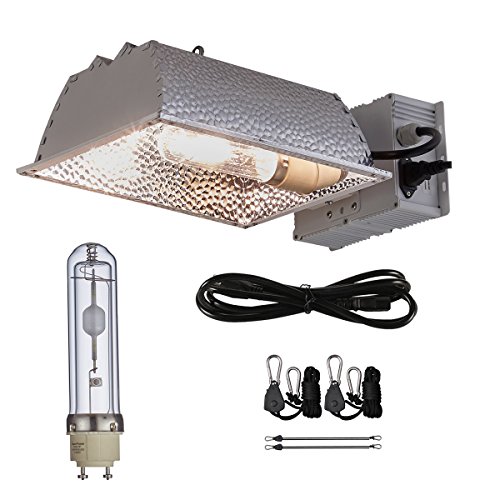
- Optimized for the bloom phase
- Sturdy reflective hood
- Being able to operate more efficiently
TopoGrow 315W CMH CDM Grow Light Kit
This cmh model boasts of high photo delivery that makes it almost similar to natural sunlight.
It is better than hid systems when it comes to light discharge.
With a coverage area of 4×4, users are guaranteed high-quality yield at harvest.
When delivered, a TopoGrow light comes with a reflector, a power cord, a 315W ballast, cmh lamps, a heavy-duty 1/8 inches rope hanger, and metal hooks.
Pros
- Low power consumption and high efficiency.
- The product comes with a rope hanger.
- Low cost and affordable price.
Cons
- Shorter lifespan compared to other grow lights
- It comes with no warranty

- Adjustable light ratchet hanger
- Product Dimensions: 20 in. X 9. 5 in. X 8 in.
- Ballast features 2-year limited
Hydro Crunch CMH 315-Watt Ceramic Metal Halide Grow Light
So far, the Hydro Crunch grow light is considered one of the best for the flowering stages of crops.
It emits less heat compared to HPS. Its coverage area of 3×3 gives you a better harvest at relatively low costs.
When delivered, users will find a ballast, an adjustable light ratchet hanger, and a reflector.
Pros
- It comes with a two-year warranty, for the ballast only
- Affordable, with high energy efficiency
Cons
- None, but the price is right.
What Are CMH Grow Lights?
You may have heard the terms Light Emitting Ceramic (LEC), Ceramic Metal Halide (CMH) and Ceramic Discharge Metal Halide (CDM).
Truth is, they are all referring to the one item; the Ceramic Metal Halide grow lights (CMH) technology.
However, the LEC is a term for a particular ceramic metal halide CMH brand.
Just like Head and Shoulders is to shampoo.
Just so we do not confuse or bug you down with too many terms, we will stick with the most commonly used term, ceramic metal halide (CMH), or just plain old CMH throughout this article.

And if we do otherwise, we will let you know.
Is that okay?
Now we continue. CMHs are only a type of Metal Halide (MH) grow lights with some amount of HPS mixed with it.
The “C” simply refers to the Ceramic arc tube used in manufacturing HPS grow lights, as opposed to the quartz material used in manufacturing the conventional MH bulbs products.
The reason for using ceramics is not far fetched.
From studies and observation, the ceramic arc tubes are designed to function at greater pressures compared to the quartz glass tubes.
One advantage this provides is that it allows grow light product manufacturers to make more accurate variations on the light spectrum.
This is not obtainable with former designs.
These CMH bulbs are really a full-on sun system offering many color temperature spectrums for your planting needs
Before we reel out the reviews for the several grow lights available in the market today, let’s show you why this grow light is your best pick.
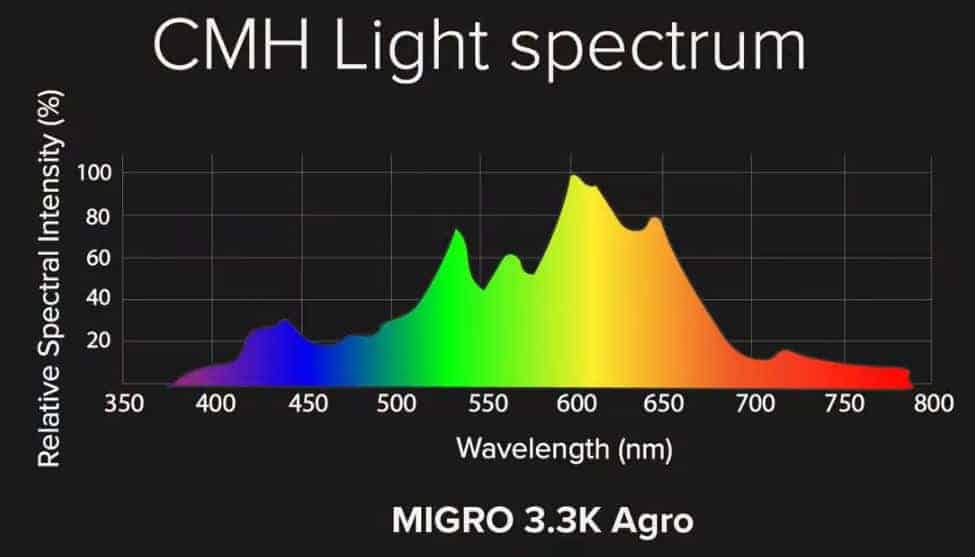
Superior PAR Efficiency | Only The Best
These grow lights have first-rate Photosynthetically Active Radiation (PAR) efficiency.
This puts them on a higher pedestal compared to other types of grow lights such as MH and HPS which are known for their high energy consumption.
Wider Spectrum
CMH has a full spectrum coverage unique to them. This is only possible because of the super-efficient ceramic arc tube used in the design.
For one, ceramic arc tubes are known to do well under high temperatures.
Plus, their design allows for a balanced distribution of light rays across all the crops.
- Light Emitting Diodes (LED) are more energy-efficient compared to CMH light.
- LEDs emit a lesser amount of heat compared to CMH lights. That simply means, while you can position LED lights close to your crops without any fear of burns and overheating, you cannot do the same for Ceramic Metal Halide (CMH) grow lights. A healthy distance is required.
- LEDs have longer lifespans. However, LEDs cost a lot higher if price is a concern.
- LEDs have greater light coverage than CMH grow lights and can be used for all the growth phases of your crops.
CMH vs. HPS Lamp Bulb Products
Though the CMH grow light and High-Pressure Sodium (HPS) lights could fall into the same category for their similar bulb designs they are different.
Most user ratings put HPS ahead of CMH grow light in terms of effectiveness.
While a great amount of Photosynthetically Active Radiation (PAR) from HPS light is emitted by the red light, CMH light is known to provide a more balanced PAR for your crops at the flowering and vegetative phases of their growth.
In any case, the term "better" would depend on the point of use and the outcomes you want as a gardener.
Across the board, however, HPS rank higher.
Are CMH Bulb Light Products Safe?
First, these are not normal light rays. The bulb products are meant to mimic the properties of sun rays, at best, for plant growth.
Overexposure to the sun puts you at risk of sunburn and UV absorption.
The same is true of CMH grow light as it is essentially a sun system. When using them, growers are advised to wear protective gear including, a pair of sunglasses and a long sleeve shirt or pair of gloves.
With the right protection, the answer to the above question is a "yes". Without protective gear, the answer is "no".
While Ceramic Metal Halide grow lights will continue to be relevant, gardeners must shield themselves from radiation as through avoiding natural sunburn.
The eyes are the most affected parts of the body when exposed for too long.
This is because there have been more customers complaining about itchy and teary eyes as opposed to those complaining of UV burns.
In any case, stay safe when watering your plants.
Always call the attention of a technician in the event of a malfunction.
Do not repair a faulty grow light yourself. Except of course if you are a technician too.
We hope the above reviews and advice would help you make better buying decisions when you go shopping or carting online for your next CMH grow light or grow kit.
Ensure to look out for features such as energy efficiency, heat per watt, light spread or coverage and of course, the warranty.
When you go shopping, also remember to buy the required tools for protecting yourself.
Besides a pair of protective glasses and arm-length hand gloves, see to it that you also have boots on.
And don’t forget to protect yourself.
What is the Best 315w CMH Bulb For Growers?
There are specific bulbs to go with the Ceramic Metal Halide grow light, depending on which.
However, one bulb type has received the most customer reviews and positive feedback yet.
It is the Protopia Ceramic Metal Halide Grow Light bulb.
This product is a lot more available and affordable compared to competing products such as Phillips.
However, it has one major flaw. With just 15,000 hours of active time, the Protopia bulb has a much shorter life span than Protopia which has 20,000 hours.
That simply means users must be ready to replace it more often than they would a Philips product. Moreover, it has a lower Color Rendering Index (CRI) of 90.
The lamp bulb mostly comes in 315 Watts and 630 Watts. It is also available in 3100K and 4200K, depending on your specs or choice of use.
For most growers who still consider cost as an issue, this product will prove to be a low-cost option.
If, however, the price is not a factor, consider purchasing Philips.
Final Thoughts
There are so many choices out there for grow lights for your indoor garden. Sometimes cheaper is not always better, so be aware of that when you check the price.
You certainly get what you pay for. Ensuring the success of your growing plants is really what you need to take in mind whether you choose LED or CMH grow lights.
Drop a comment below and let us know if this was helpful.
Meet Jeremy Starke
I've been growing vegetables since I was 12 — over 30 years in the dirt. I share what actually works in my own Zone 6b garden, and what I wish someone had told me when I started.
Zone 6b · North Carolina · Gardening since age 12 Read My Story →Frequently Asked Questions
What is a CMH grow light?
Ceramic metal halide, a type of HID light that produces a broad, sun-like spectrum. Growers like it for strong color rendering and good plant quality.
Are CMH grow lights better than LED?
CMH gives excellent full-spectrum light and costs less to buy, while LED runs cooler and uses less power. Many growers now lean to LED for efficiency.
What size CMH light do I need?
A 315W CMH covers about a 3x3 to 4x4 foot space. Add more fixtures for larger grow areas.